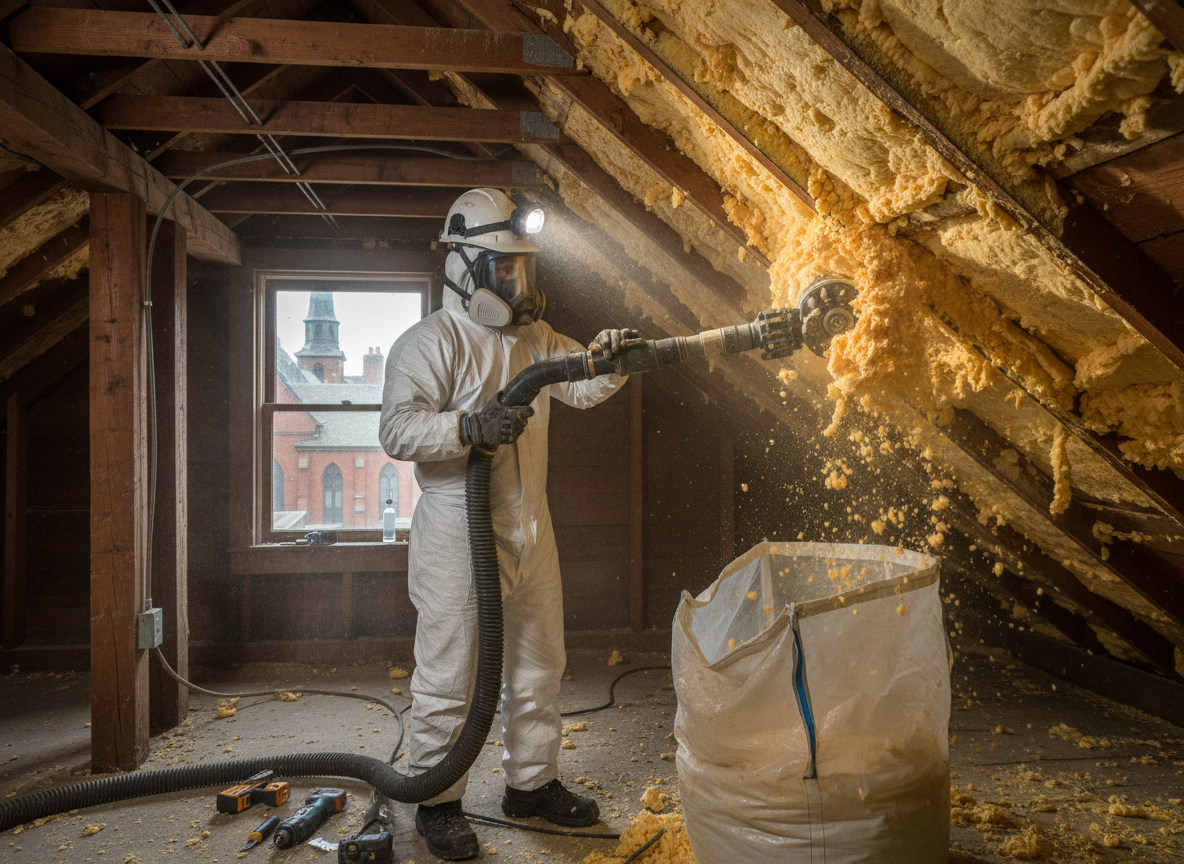
Thermal spray foam removal in Boston requires careful assessment of older cavity wall constructions common in terraced homes near Market Place and along the River Witham. Many properties from the mid-20th century received foam injection that now traps moisture against the fenland clay soils, leading to accelerated timber decay and reduced thermal performance once winter temperatures drop. Technicians must cut precise access points, apply controlled heat to break down the polyurethane bonds, and extract residue without disturbing original brickwork or lath and plaster interiors.
Homeowners in Boston often discover failed foam during loft conversions or when damp patches appear on gable ends facing the prevailing winds off the Wash. The process demands negative air machines and HEPA filtration to contain dust in these compact urban plots where neighbouring properties sit close. Incomplete removal leaves behind off-gassing particles that can affect indoor air quality for months, especially in poorly ventilated Victorian terraces still prevalent around the town centre.
Local building practices in the Boston area mean many installations bypassed modern vapour control layers, so removal crews routinely encounter foam bonded directly to masonry that has absorbed groundwater. This requires staged drying periods and substrate inspection before any re-insulation work begins. Edge cases include foam that has migrated into electrical chases or around chimney breasts, demanding extra time and specialist tools to avoid damage to period features.
Technician insight
In Boston, the thing that catches most people out with thermal spray foam removal is the way older cavity walls around the market place have absorbed groundwater from the surrounding fens, so the foam sticks harder and releases more dust than in drier inland properties.
Cavity Wall Foam Failure Near The River
A terraced home off Market Place showed recurring damp on the gable wall after heavy autumn rain. Inspection found thermal spray foam bridging the cavity and holding moisture against the brick. Crews set up containment, applied heat to loosen the material, and extracted it fully before allowing the wall to dry. The property regained proper ventilation and the damp issue resolved.
How it works
- 1
Initial Survey And Moisture Mapping
Technicians inspect the property in Boston to identify foam locations, test wall moisture levels, and map access routes while noting any original construction details.
- 2
Safe Access And Containment Setup
Dust barriers and extraction equipment are installed to protect living spaces, particularly important in the dense layouts around 31a Market Place.
- 3
Heat Application And Material Breakdown
Controlled thermal equipment softens the foam for removal without excessive force on fragile substrates common in Lincolnshire fen homes.
- 4
Extraction, Cleaning And Final Inspection
Residue is vacuumed out, surfaces are cleaned, and the site is checked for remaining material before handover.
Pricing
Cost depends on property age, foam depth, and access difficulty in Boston homes.